
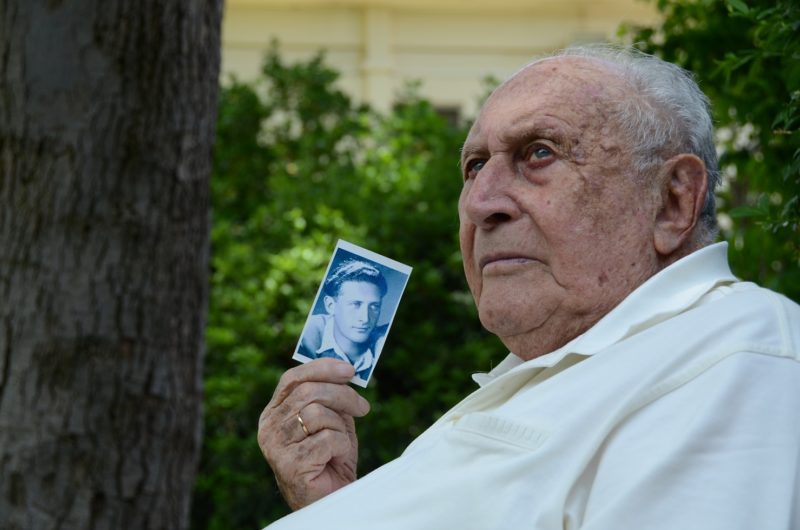
Yehuda Maymon
Our main operation that night was throwing Molotov Cocktails at Cyganeria Café downtown, where we knew senior Nazi officers would come to celebrate Christmas. And indeed, some of them were killed there. We raised Polish flags on public buildings and stuck posters calling the Poles to rebel against the Nazis. Although we did not declare this to be the Jewish underground’s operation, in order to prevent a Nazi revenge on the ghetto residents, it was still an extremely important action which proved that Jewish blood would not be spilled with impunity and that we would not go like sheep to the slaughter.
I still can’t explain how I survived. In so many instances I felt a divine intervention had saved me from immediate death. In one case I was admitted to the Auschwitz clinic. According to the rules, if you hadn’t recovered within fourteen days, you were sent to the gas chambers and to the crematorium. Since I still had a high fever on the thirteenth day, an SS supervisor signaled me out for the crematorium the next day.
But beyond the fear for my own life, I was also afraid of something else: that if I died, the story of the courage and resistance of the underground would disappear with me. I felt a powerful need to tell someone in the outside world about what our underground group had done, so that the world would know that Jews had fought back against the Nazis and had not gone like sheep to the slaughter.
In the room where I was lying, there was a medical person who was older than me and whom I considered to be a decent person. The hospital staff in Auschwitz did not wear identifying badges, so I did not know anything about his background or whether he was Jewish. Nevertheless, I decided to take the risk and tell him about the underground movement, hoping that if he survived Auschwitz, he would one day be able to tell the world our story of courage and resistance.
To my surprise, it turned out that this man had also been a member of the Bnei Akiva youth movement, of which I was a member, and that he even knew some of its senior members. He approached the hospital secretary, who was Jewish and also the deputy commander of the communist underground movement in the camp, and told him about me.