
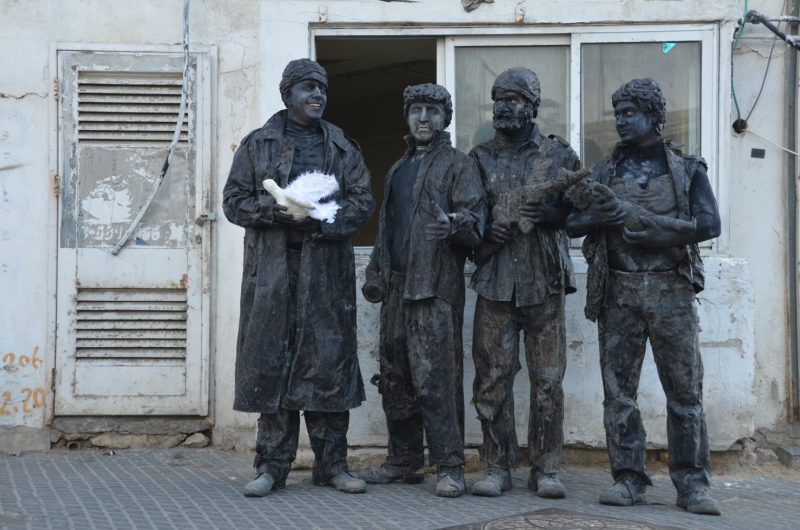
Yinon Tzafrir and the ORTO-Da Theatre Group “The moment I saw the monument of the Warsaw ghetto in Poland I knew these characters deserve to be alive and not only remembered as statues. I see these characters as a sign of victory of the human spirit since the show ‘Stones’ was awarded as one of the 10 best shows in the world. Even though its a deep and heavy subject I decided to celebrate the human spirit and I consider the show to be a comedy. These characters had won and are alive in our hearts. I believe we succeeded to take the ugliest time in human history and to turn it into one hour of beauty on stage.”

Holocaust surviver, Łódź Ghetto “Out of 70,000 children at Łódź Ghetto, I’m one of the only three children who managed to survive the Ghetto but being a survivor came with a hefty price. From the first day I was born in the ghetto until it was released, for almost five years, my parents hide me in different places. In the beginning, I was hidden at a clothing factory in the ghetto but after a year and a half, my parents had to move me to a different hiding place – The ghetto cemetery. My dad who worked at ‘Chevra Kadisha’ (an organization that sees to it that the bodies of deceased Jews are prepared for burial according to Jewish tradition) hide me in one of the ‘Tahara rooms’ (A room where the corpses were washed (Tahara) before burial), so even if I met people I couldn’t really have a proper ...

Holocaust survivor, Czortkow, Poland (Today located in Ukraine) “Marta, my child, we have to separate. the situation has deteriorated and it’s no longer safe for you to stay at Czortkow. There are almost no Jews left in the ghetto and if the germans will found you they will defiantly kill you. As it seems, In a few more days I won’t even be allowed to continue working at the pharmacy so there is no way I could keep hiding you here in the basement. Therefore I decided to send you to Warshaw to live with the Schultz family. They are good friends of your father and will take good care of you. My mother told me that while living with the Schultz I will have to live under an assumed identity: My new name was Christine Grinavic and my nickname was Chrisia. I was born in the countryside and was a Catholic Christian who went to church every Sunday ...
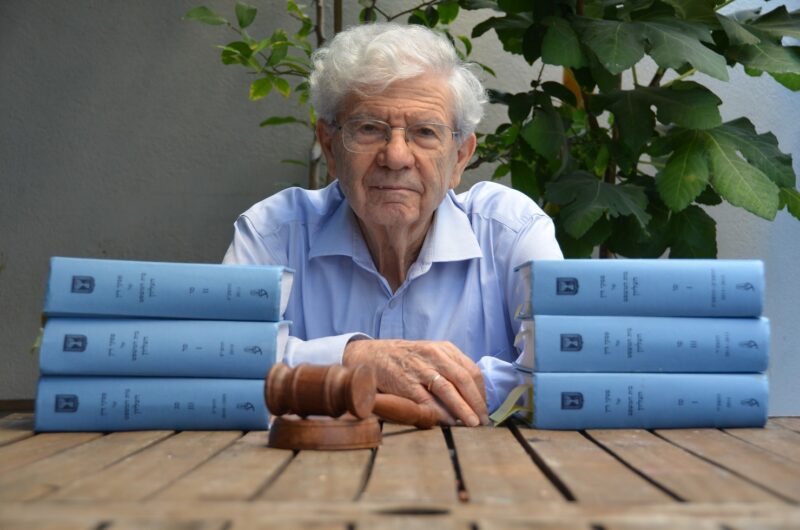
Former Chief Justice of the Supreme Court of the State of Israel The National Perspective I look at the experiences of my life, and I ask: What is the lesson I have learned from all this? To what extent have these events shaped my legal worldview? What effect has Arik Brick had on Aharon Barak? I have no clear answer to these questions. The line between facts and hypotheses is blurred. Yet, what is my answer to these questions, even if there is a rationalization of my past experiences in this answer? My answer is this: there are three main lessons that emerge from my personal history, and what is also the history of my generation of Holocaust survivors. The first lesson is the centrality of the State of Israel as being the state of the Jewish people. I am convinced that if we had a country of our own, ...
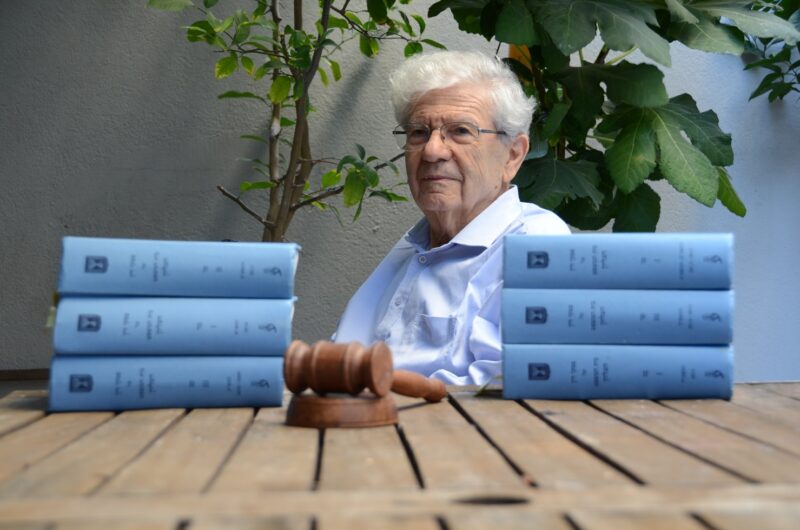
Former Chief Justice of the Supreme Court of the State of Israel The Holocaust Made Me Optimistic The Personal Perspective I was born in the year 1936 in the city of Kaunas in Lithuania. My father was a lawyer. He didn’t work in the field, he was the manager of the Artziyisraeli office in Lithuania. My mother was a teacher of Latin and Lithuanian history. Her father – my grandfather – was a rabbi who served as the rabbi of two communities, one of Rokiškis and the other of Obeliai (Abel). Under the Molotov-Ribbentrop Pact, Lithuania was given to Russian administration. Sometime after, Lithuania was annexed to the Soviet Union. With the beginning of Operation Barbarossa the Germans conquered Lithuania (in June 1941). I remember the flyover of German war planes above Kaunas very well (on 22 June in 1941). This is how the Jewish holocaust in Lithuania began. This ...
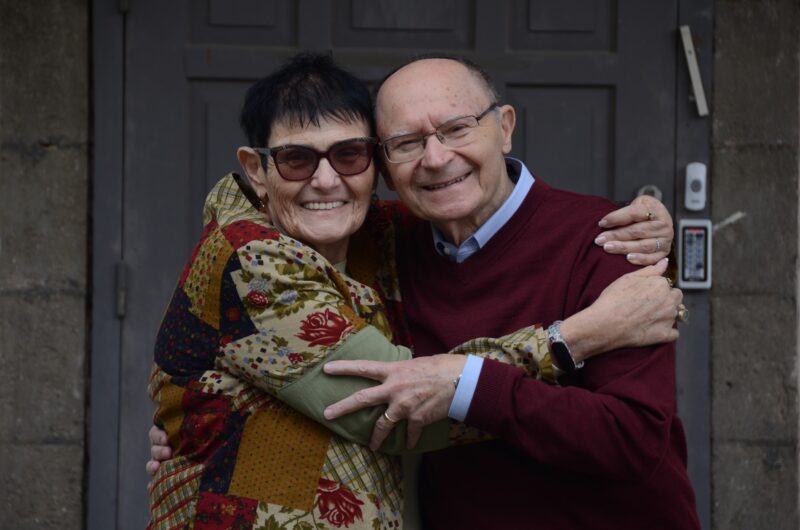
Bernard: “There were always question marks hovering over my personal and family history. I knew I was born in Poland and that I was hidden by a Righteous Gentile Polish family. I knew they were not my family, but I didn’t know who I was. After the war, I was placed in a Jewish orphanage, and eventually, I was adopted by a Jewish family. Until today I don’t have an official day of birth so I can only say that I’m approximately 82 years old. My original name was Bolek Szczycki, but it was badly misspelled by the orphanage, which made it impossible for my relatives to find me after the war had ended. I was also too young to search for my relatives myself, so at the end of the war, I was all by myself with not even one person in the world I can call Family. Back then there ...

a Third-generation Holocaust survivor. I’m still looking for the million-dollar question- how did something like that happen in a civilized society? That is the reason why I find myself repeatedly going back to Poland. So far, I visited the death camps three times in an attempt to find an answer to that question. An answer I’m not even sure I will ever get. I was seventeen when I went on an educational trip to the death camps in Poland for the first time. At the time, I wasn’t capable of comprehending the events that took place nor capable of understanding the depth of the emotions that arise while being there. I wasn’t crying or behaving as I was “expected” to react, which caused me to feel apathetic to my surroundings as well as to the stories that were being told. In addition to all of that, I needed to face my own ...
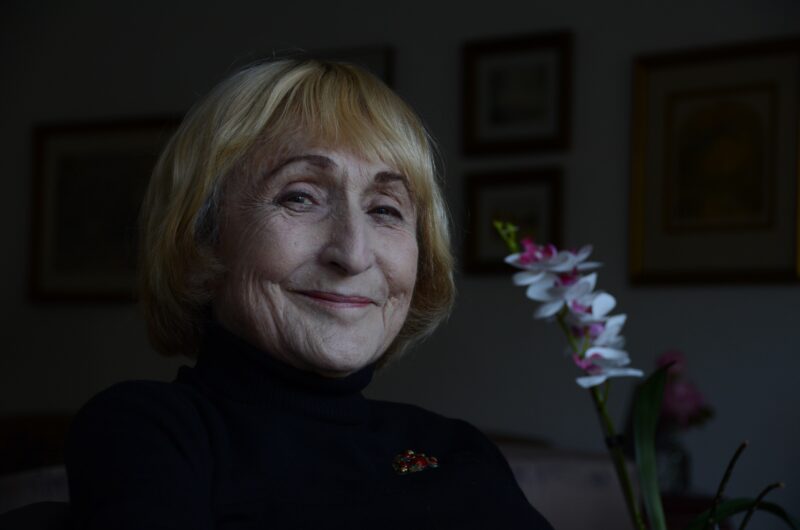
“Four decades later I visited Berlin for a professional conference and during that visit, there was a grand reception that was held for us in the Town Hall. I can still remember the ‘Mashgiach’ (a Jew who supervises the kashrut status of a kosher establishment) running through the tables to check that everything is kosher. It made me think that if Hitler could rise from his grave, he would definitely hang himself on the tallest nearby poll. That was the first time in my life when I took a Selfie! A proud Jew, Free in Berlin eating Kosher food in the Town Hall, was definitely a moment to hold down too.”
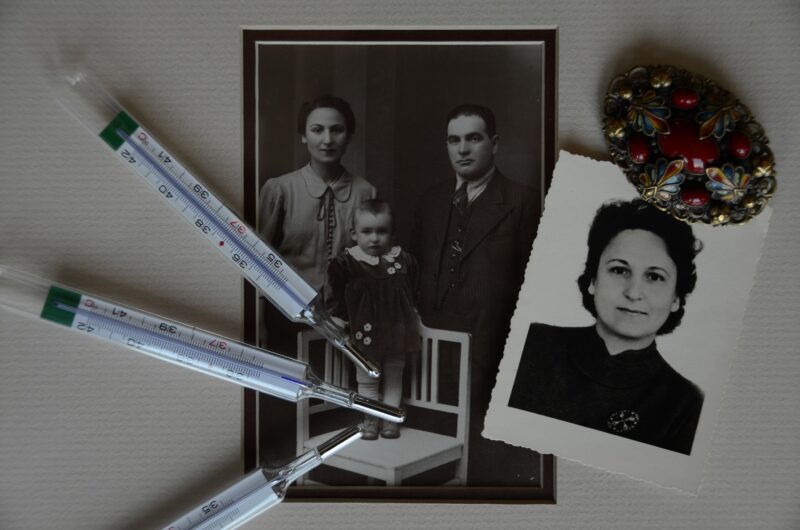
“I was born in Sambor Poland now Ukraine. When the second world war erupted my parents were more afraid of the Russian forces than of the Germans. My Parents thought: ‘What in the world can happen if we live under the rule of the cultural nation who brought to this world: Goethe, Beethoven, and Kant? Back then, no one could have imagined the Aktions, the Gas chambers, and the crematorium. Life in Sambor Ghetto was harsh but they became unbearable when the Germans started with the Aktions. I still remember how in one of the Aktions while hiding in the basement I saw through a crack in the wall how the Germans forcibly took my grandparents away. My mother understood really quickly what the future has in store for us if we get caught so she came up with a plan B that included suicide by swallowing mercury. Somehow she ...
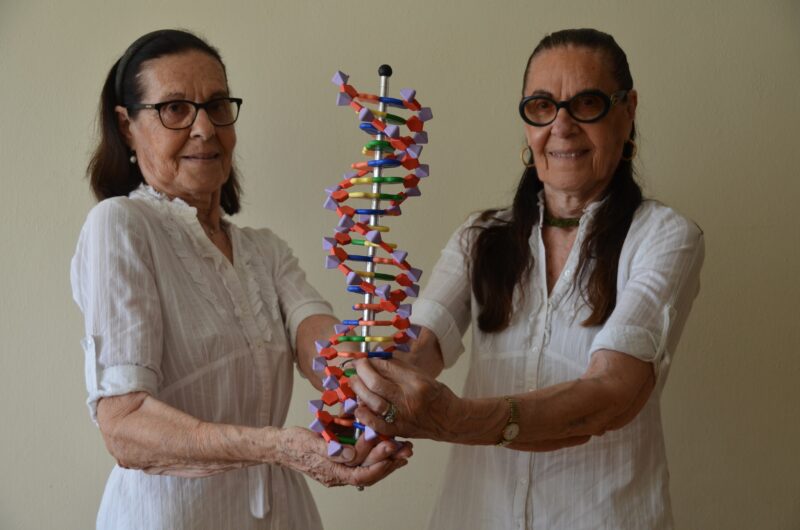
Holocaust survivors, The twins of Auschwitz. “When we arrived at Auschwitz we were only seven years old and it was a sight that we will never forget. We didn’t realize it in real-time but we entered into the gates of Hell. Loud shouts in German, SS soldiers holding attack dogs that wouldn’t stop barking, thousands of terrified people, and the feeling of great calamity. From all of the chaos around us, our mother heard someone shouting in German ‘Zwillinge’ (twins in German) and didn’t really know what to do. She asked people around her if it’s worthwhile to say she has twins with her and the answer was that she has nothing to lose. We were taken to the twins block and in an instant, we were transformed from Humans beings to the guinea pigs of the “death angel” of Auschwitz, Dr. Josef Mengele. Mengele believed that if he could unlock the secrets of heredity ...